NeurIPS 2025: Auto-Compressing Networks for efficient neural representations
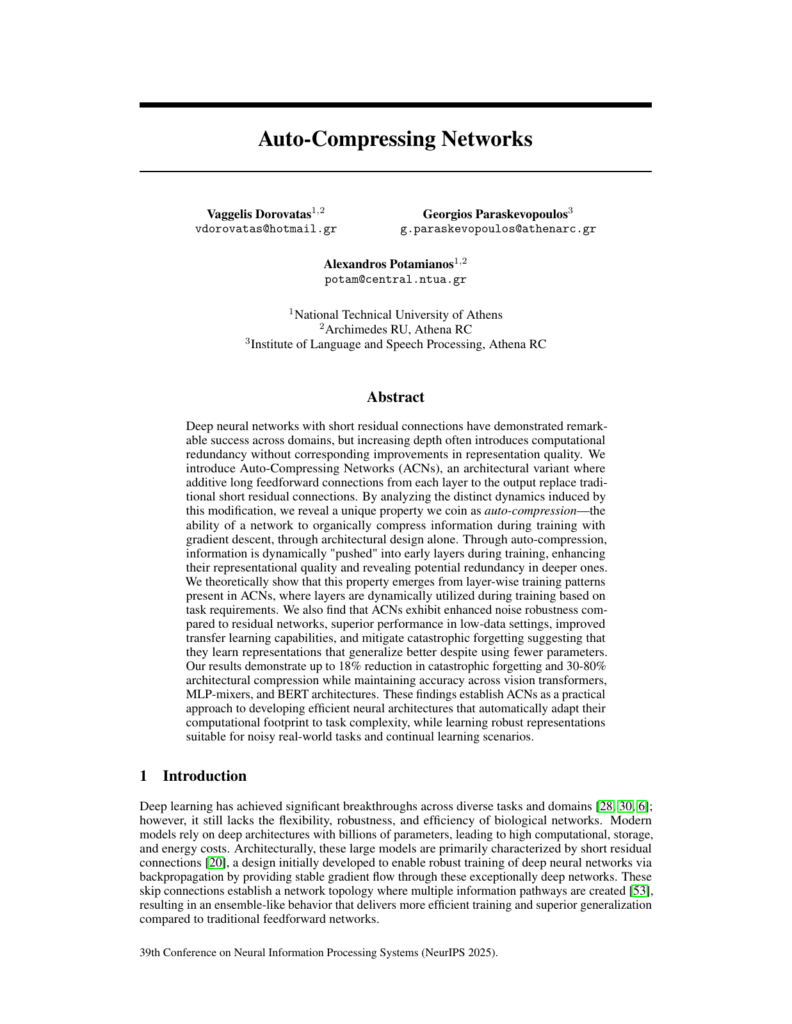
Auto-Compressing Networks explore how architectural design can reduce redundancy while retaining useful learned representations.
Auto-Compressing Networks explore how architectural design can reduce redundancy while retaining useful learned representations.
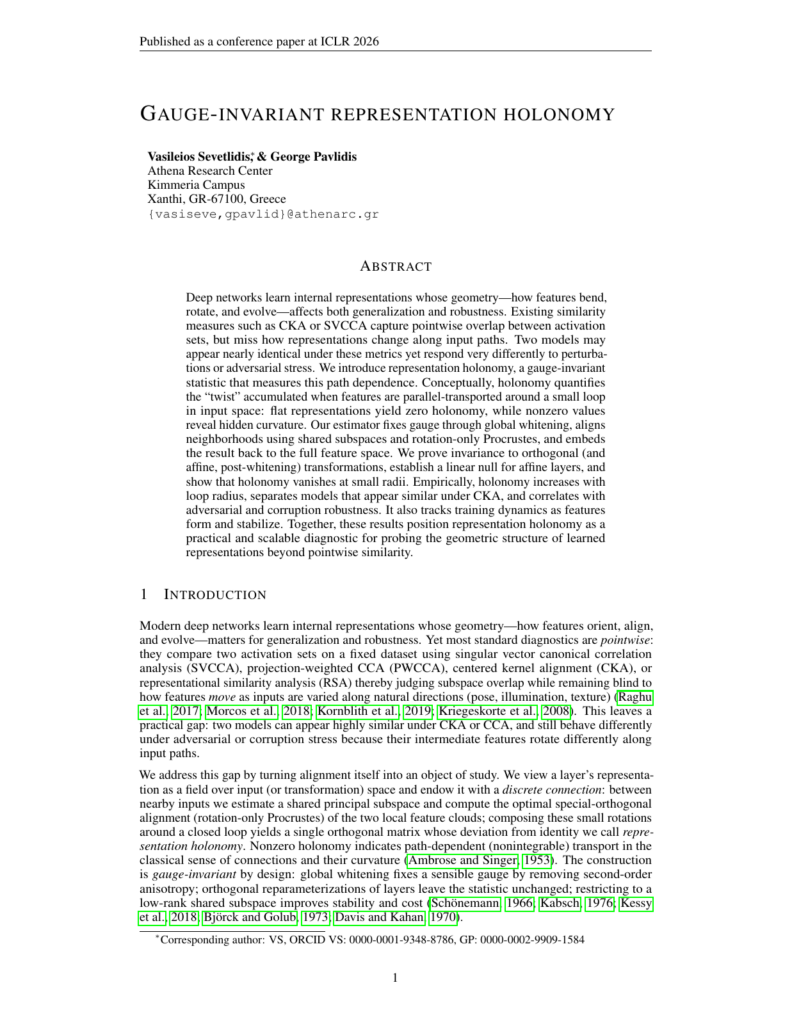
Representation holonomy examines how neural features change along input paths, extending analysis beyond pointwise similarity.
The paper “Prescriptive SVD-Inspired Attention via Spectral Energy Retention” has been published in Transactions on
“Representation-Diverse Self-Supervision for Cross-Domain Bioacoustic Learning in Low-Resource Settings” was presented at ICASSP 2026. The
The paper “Process-Tensor Tomography of SGD: Measuring Non-Markovian Memory via Back-Flow of Distinguishability” was published
“Two-Stage Angular Alignment for Positive-Unlabeled Learning” proposes a geometric weak-supervision method for settings where only
“Interpretable Vision Transformers in Image Classification via SVDA” extends the group’s SVD-inspired attention work to
The paper “Angular Regularization for Positive-Unlabeled Learning on the Hypersphere” received TMLR certification and was
The article “Geometry Meets Attention: Interpretable Transformers via SVD Inspiration” was published in IEEE Access
The article “Monocular Depth Estimation: A Thorough Review” was published in IEEE Transactions on Pattern