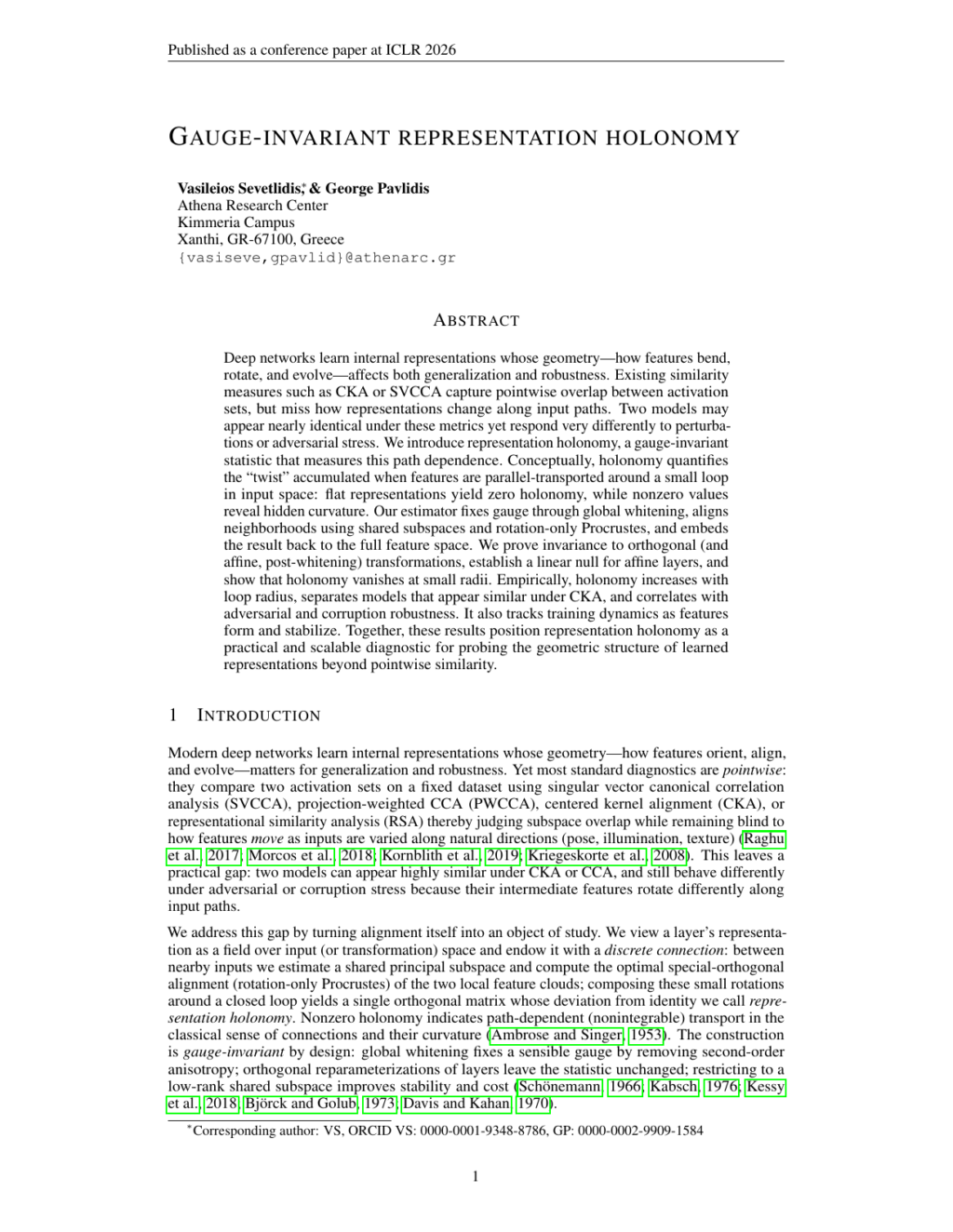
The paper “Gauge-invariant representation holonomy” by Vasileios Sevetlidis and George Pavlidis was published at ICLR 2026.
The work studies how learned neural representations change along paths through the input space. Its gauge-invariant holonomy statistic captures geometric structure that pointwise similarity measures can miss, connecting representation analysis with robustness and training dynamics.
- Authors: Vasileios Sevetlidis, George Pavlidis
- Venue: International Conference on Learning Representations (ICLR 2026)
You may also like
-
NeurIPS 2025: Auto-Compressing Networks for efficient neural representations
-
TMLR 2026: prescriptive SVD-inspired attention via spectral energy retention
-
Towards Heritage World Models: from digital twins to predictive heritage systems
-
ICASSP 2026: representation-diverse self-supervision for bioacoustic learning
-
AISTATS 2026: process-tensor tomography of SGD and training memory